
Sony ZV-1 vs Sony a6100 for Video? | Which should you buy for videos?
Sony ZV-1 vs. Sony A6100: Which Camera Is Better for Entrepreneurs Creating Video Content?
Last updated: 11-14-2026
If you've been looking for an affordable camera to create content for your business, chances are you've come across two popular options: the Sony ZV-1 and the Sony A6100.
FYI: I'm specifically referencing the Sony ZV-1 Mark 1, not the Mark 2 version.
I've been asked quite a bit about these two cameras, whether in DMs, YouTube comments, or conversations with entrepreneurs trying to figure out which camera they should invest in.
And honestly, I can understand why.
Both cameras offer an impressive amount of functionality for their price point. They have reliable autofocus, microphone inputs, clean HDMI output, 4K recording, and the ability to record for extended periods without the overheating issues you might experience with other cameras.
On paper, they seem like two cameras competing for the exact same customer.
But here's where I think most people get it wrong...
Just because two cameras have similar price points and overlapping features doesn't mean they're designed to serve the same purpose.
If you're an entrepreneur creating YouTube videos, recording educational content, hosting live streams, or building a content library for your business, the camera you choose should be based on how you actually intend to use it.
I've spent extensive time using both cameras, pushing them through long recording sessions, live streams, events, and business content creation.
So let's break down what you need to know before making your decision.
Sony ZV-1 vs. Sony A6100: What Do They Have in Common?
Before getting into the differences, let's talk about why these two cameras are so frequently compared.
Both offer an impressive set of features that make them incredibly capable video cameras, especially considering their price.
1. Unlimited Recording Without Overheating
One of the biggest considerations when buying a camera for business content is whether you can actually rely on it to record for extended periods.
There's nothing worse than getting everything set up, getting into your presentation, and having your camera shut down because it's overheated.
Fortunately, both the Sony ZV-1 and A6100 handle extended recording extremely well.
I've personally recorded for more than two hours on both cameras without experiencing overheating issues. I've also tested the A6100 recording in 4K without running into problems.
And yes, this is is without needing to use a camera fan at all.
If you're recording YouTube videos, online courses, coaching sessions, or educational content, this is a big deal.
You want to be able to press record and focus on what you're doing rather than constantly monitoring your equipment.
2. Clean HDMI Output for Live Streaming
This is another feature I believe every camera intended for serious video use should have.
Both cameras offer clean HDMI output, which means you can connect them to a capture card or streaming setup and use them as a dedicated camera for your live broadcasts.
Whether you're occasionally going live on social media or hosting a weekly show, having a camera that can integrate into your streaming setup makes a huge difference.
I host a regular live show every Friday at noon, so having equipment that can reliably handle that workflow is important.
Another benefit is that these cameras can record internally while you're simultaneously sending the video signal through HDMI.
That's a feature I've really appreciated with Sony's mirrorless cameras and the ZV-1.
3. Reliable Autofocus
Sony has done a fantastic job with autofocus, and both of these cameras are excellent in this department.
You don't want to constantly worry about whether your camera is keeping you in focus while you're talking, demonstrating something, or moving around.
Both cameras offer reliable face detection and autofocus for video.
You won't get the same eye autofocus experience found on some of Sony's higher-end models, but for most entrepreneurs creating content at their desks, the autofocus performance is more than sufficient.
4. Microphone Input
Audio matters big time.
You can have the best-looking video in the world, but if your audio sounds terrible, people aren't going to stick around very long.
Both the ZV-1 and A6100 have a microphone input, allowing you to connect an external microphone directly to the camera.
You can use a traditional shotgun microphone, a wireless microphone system, or even route audio from another microphone setup into the camera.
I've previously shared different ways to connect podcasting microphones to Sony cameras, and those workflows apply to both of these options.
Having that flexibility is especially useful when you're creating content for your business.
5. Compact and Lightweight
Neither camera is particularly difficult to travel with.
They're both relatively lightweight, compact, and easy to incorporate into a basic content creation setup.
You don't need an enormous camera rig just to record a YouTube video or capture content while traveling.
6. Comparable Video Specifications
For the average entrepreneur, the video specifications are also quite similar.
Both cameras offer:
1080p recording at 24, 30, and 60 frames per second.
1080p recording at 120 frames per second for slow-motion footage.
4K recording up to 30 frames per second.
There are additional high-frame-rate recording options on the ZV-1, but most business owners aren't going to need those for their everyday content.
If your goal is to record talking-head videos, educational content, interviews, or general business content, both cameras provide more than enough capability.
The Biggest Differences Between the Sony ZV-1 and A6100
Now that we've covered the similarities, let's talk about where these cameras start to separate themselves.
And this is where your intended use case becomes incredibly important.
1. The Lens: Fixed vs. Interchangeable
This is probably the biggest difference between these two cameras.
The Sony ZV-1 is a point-and-shoot camera with a permanently attached lens.
It has a 24-70mm equivalent zoom range with an F1.8-F2.8 aperture, which makes it a versatile option for everyday video creation.
You get a decent amount of flexibility without having to purchase additional lenses.
The A6100, on the other hand, is an interchangeable-lens camera.
That means you can change lenses depending on the type of content you're creating.
For example, I use a 10-18mm lens when I want a wider angle for vlogging.
If I want a sharper image and that nice background separation, I can use something like the Sigma 16mm lens.
That flexibility is a big advantage if you're building a more permanent video setup or anticipate expanding your content creation capabilities over time.
However, there's a trade-off.
If you're someone who plans to purchase the A6100, keep the kit lens on it, and never change anything, you might not need the flexibility of an interchangeable-lens camera.
In that situation, the ZV-1 could be perfectly fine.
But if you want options, the A6100 gives you room to grow.
2. Sensor Size and Low-Light Performance
Another difference is the camera sensor.
The A6100 uses a larger APS-C sensor, while the ZV-1 uses a smaller 1-inch sensor.
Does this mean the ZV-1 produces bad video?
Absolutely not.
If you're recording indoors with proper lighting, the difference might not be particularly noticeable for your intended use.
However, if you're frequently recording in lower-light environments, especially while traveling or vlogging, the A6100's larger sensor can provide an advantage.
For most entrepreneurs recording at a desk with a decent lighting setup, I wouldn't make this the deciding factor.
There are other differences that I think matter much more to your everyday workflow.
3. The Battery Door Debacle
This is something I don't think gets discussed enough when comparing these cameras.
The A6100 has a battery compartment with a small access door that allows you to route an external power cable through the bottom of the camera.
This is important if you're planning to use your camera for long recording sessions or leave it connected to AC power.
The ZV-1 doesn't have that same convenient cable-routing door.
The ZV-1's tripod mounting point is positioned in a way that makes it difficult to use the camera on a tripod while keeping the battery compartment open.
So if you're trying to power the camera externally using an adapter, you're going to run into some inconveniences.
You can work around it, but why introduce unnecessary complications into a setup that's supposed to make content creation easier?
The A6100 is much better suited for this kind of permanent setup.
However, with a small camera base-plate attached to the camera, you can easily solve this problem.
But without it, you can't open the camera door to attach the camera to a tripod if you plan to use and AC power adapter.
4. Build and Long-Term Reliability
Another reason I appreciate the A6100 is that it's built around a more traditional mirrorless camera design.
I've used these cameras for events, client projects, my own content, and course recordings.
I've pushed them through five-, six-, and even eight-hour sessions while connected to external power.
And they've held up.
That kind of reliability matters when your camera is part of your business infrastructure.
There's also something to be said about having an interchangeable lens.
If something happens to the lens, you can replace the lens without necessarily replacing the camera body.
With a fixed-lens camera like the ZV-1, damage to the lens assembly can become a much more expensive problem.
It's not something that should necessarily scare you away from the ZV-1, but it's worth considering if you're purchasing used equipment.
One More Camera You Should Consider: The Sony A6400
Before I give you my final recommendation, there's one more camera I want to mention.
The Sony A6400.
Here's why.
The ZV-1 actually includes picture profiles, which can be useful if you want to work with flatter footage and have more flexibility when color grading.
The A6100, on the other hand, doesn't offer the same picture profile options.
It has basic creative styles, but if you're planning to work with a professional editor or eventually hire someone to handle your video production, those additional picture profile options could become important.
And this is where the A6400 enters the conversation.
You get the interchangeable-lens system of the A6100, along with additional video features, including picture profiles.
Even better, you can sometimes find a gently used A6400 for around the same price as a new A6100.
If color grading and handing footage off to an editor are important parts of your future workflow, I'd seriously consider the A6400.
But if those features aren't particularly important to you, the A6100 remains an excellent option.
Sony ZV-1 vs. A6100: Which Camera Should Entrepreneurs Buy?
Let's keep this practical.
Buy the Sony ZV-1 If...
You're primarily looking for a compact, all-in-one camera that you can take with you wherever you go.
I'd recommend the ZV-1 if:
You're doing family vlogging or casual lifestyle content.
You travel frequently and want something lightweight.
You want a camera that doesn't require purchasing additional lenses.
You're recording occasional YouTube videos.
You want a secondary camera to supplement your primary setup.
Your content creation is split between being on the go and recording at your desk.
I genuinely adore the Sony ZV-1 Mark 1.
It's a capable little camera, and I think it serves its intended purpose extremely well.
If you're traveling, documenting your day, capturing behind-the-scenes content, or creating videos on the go, it's a fantastic option.
Buy the Sony A6100 If...
You're primarily creating content from a consistent location.
I'd recommend the A6100 if:
You're recording YouTube videos at your desk.
You're hosting regular live streams.
You're recording online courses or educational content.
You want to use an external power adapter.
You want the flexibility of interchangeable lenses.
You're building a more permanent content creation setup.
You want a camera that can handle consistent, extended use.
For entrepreneurs who are serious about creating content every week, this is where I think the A6100 really shines.
My Definitive Choice: The Sony A6100 for Most Entrepreneurs
Here's my recommendation.
If you're an entrepreneur creating content from a stabilized setup, primarily sitting at your desk with your camera mounted on a tripod, the Sony A6100 is an amazing find.
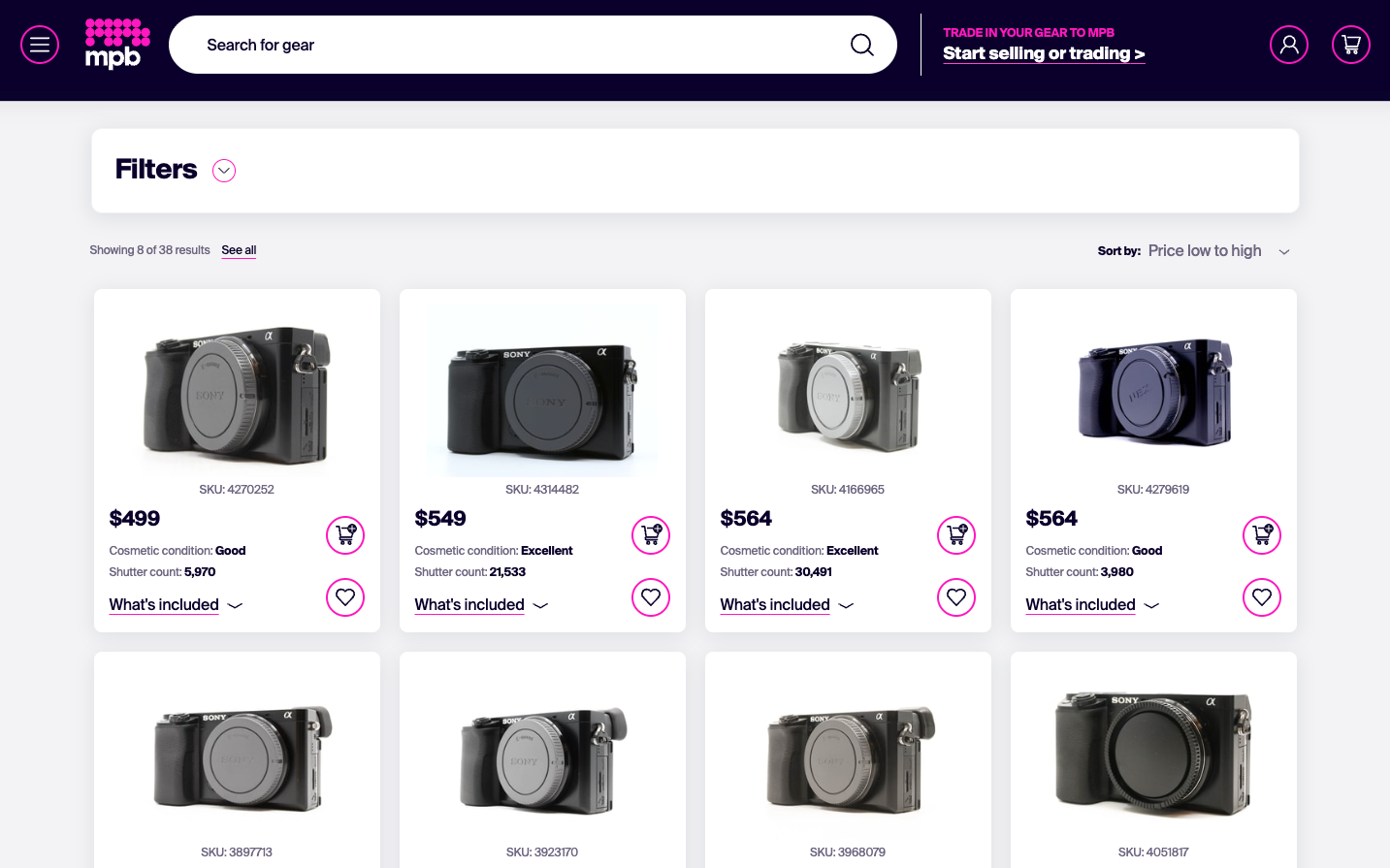
And when you can find one gently used for as little as $499 on a marketplace like MPB.com, it becomes an even better investment.
Yes, you'll need to purchase a lens if you want that nice, blurry background kind of look.
But there's another reason I prefer the A6100 that has less to do with image quality and everything to do with your workflow.
It's something I call minimizing micro-frustrations.
Stop Introducing Unnecessary Friction Into Your Content Creation Workflow
Here's something that might seem small but makes a big difference over time.
When you're using the A6100 with an interchangeable zoom lens, you can physically adjust your focal length to frame your shot exactly how you want it.
Let's say you're recording at your desk and want to zoom in slightly to eliminate some distractions in the background.
You adjust your lens, get your framing exactly where you want it, and you're good to go.
When you turn the camera off and back on again, your lens remains at that previously selected focal length.
You don't have to recreate your framing every single time.
With the ZV-1, because you're working with a powered zoom lens, you can find yourself having to readjust your zoom and framing when you power the camera back on.
And if you're doing that every time you sit down to record, those little inconveniences start adding up.
For me, those inconveniences are like trying to wade through mud.
It's not that any one of them is particularly difficult. It's that they introduce unnecessary friction into something you're going to be doing repeatedly.
I want to sit down, turn my gear on, and record.
Period.
I don't want to spend the first several minutes of every recording session readjusting things that should already be where I left them.
Pro tip: You can always spot micro-inefficiencies within your creative process when you notice you're constantly annoyed have to fix, adjust, or repetitively do something.
And this goes beyond cameras.
Any repetitive actions you're doing before, during, or after recording should eventually become a system.
Some systems you can create through better processes. Others require making the right equipment purchase.
Either way, the goal is to eliminate unnecessary steps.
Think about how often you're going to use this camera.
For some entrepreneurs, that's once or twice a week. For others, it's every single day.
If you're going to be using something that frequently, why would you intentionally purchase an inefficiency?
Your equipment should make creating content easier, not introduce another obstacle between you and getting the work done.
That's why I lean toward the A6100 for most entrepreneurs.
It's a dependable workhorse, gives you the flexibility to change lenses, handles extended recording sessions, and makes it easier to create a consistent, repeatable recording environment.
And when you can pick one up gently used for around $499, you're getting a whole lot of camera for your money.
But There's One Important Exception...
If you're going to be splitting your content creation roughly 50/50 between being on the go and recording at your desk, I'd actually choose the Sony ZV-1 Mark 1.
If you're traveling, documenting your process, creating lifestyle content, and occasionally recording at your desk, the ZV-1's compact all-in-one design makes a lot of sense.
You don't have to worry about carrying additional lenses or building out a more involved camera setup.
It's a great little camera for that particular use case.
But if your primary goal is building a consistent content creation machine for your business, I'd put my money on the A6100.
Final Thoughts
At the end of the day, don't get caught up in comparing cameras simply because they have similar price tags.
Think about how you're actually going to use the camera.
Are you building a permanent YouTube recording setup? Are you hosting weekly live streams? Are you recording online courses?
Or are you looking for something you can throw in a bag, take on vacation, and use to document your everyday life?
Those are two different use cases, and they deserve two different buying decisions.
For most entrepreneurs with a stabilized, tripod-based recording setup, my vote is the Sony A6100.
For entrepreneurs who need a more portable, all-in-one camera for a combination of travel and desk-based content, the Sony ZV-1 Mark 1 is the better choice.
And don't overlook the used market. Finding a gently used A6100 around $499 on MPB.com makes this an especially compelling purchase.
Remember, the goal isn't to own the camera with the most features.
It's to own the camera that helps you create consistently, eliminates unnecessary friction, and makes showing up for your business easier.
Now I'm curious: Which camera would you choose?
The Sony ZV-1 or the Sony A6100?